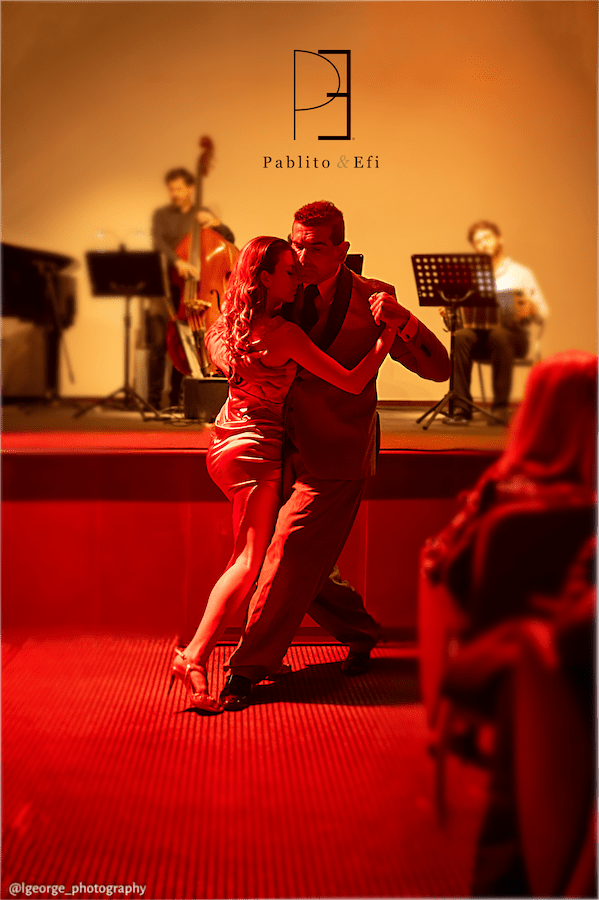
On April 18, 2026, Pablito & Efi did not dance at the Teloglion, they dismantled the room.
There are evenings one attends, and there are evenings that indict the very poverty of what we too easily call performance. On April 18, 2026, what took place at the Teloglion Foundation of Arts was not merely a concert, nor even a tango event in the conventional European sense. It was an artistic confrontation, a reminder that when tango is stripped of vanity and returned to its existential core, it remains one of the most dangerous art forms ever placed before a live audience.
From the first notes of Los Perdidos Quintet, the atmosphere in the hall changed with almost surgical precision. Piazzolla was not interpreted so much as reopened. The quintet did not offer nostalgia, nor the polished museum-piece reverence that too often sterilizes nuevo tango in formal venues. Instead, they exposed its fractures: the violence beneath lyricism, the erotic tension beneath discipline, the urban melancholy that still stalks every phrase. Their reading had nerve, intelligence, and, more importantly, risk.
Then Pablito & Efi entered quietly, almost offensively so. In an era where performers frequently arrive pre-loaded with gestures begging to be admired, they did something far more radical: they refused to announce themselves. They simply stood. And in that first still embrace, the room was already theirs.
This is what separates artists from dancers. Technique can be taught; presence cannot. The first movement did not feel choreographed. It felt inevitable, as though the music had finally found the human bodies it had been searching for all evening. Pablito did not lead in the crude sense of command; he listened through motion. Efi did not follow in the reductive vocabulary of tango orthodoxy; she answered, contradicted, expanded, and completed. What unfolded between them was not the familiar grammar of leader and follower, but something more unsettling: a shared intelligence moving faster than language.
That is why the performance was so disarming. It was not beautiful in the safe sense. It was beautiful in the dangerous sense.
At times, Efi seemed less a dancer than the embodied afterimage of the bandoneon, tensile, fluid, cutting through silence with a kind of merciless elegance. Her stillness was as articulate as her movement. She understood the rarest principle in performance: tension is not created by speed, but by restraint.
Pablito, meanwhile, brought an interpretive maturity that few couples on the European scene currently sustain. There was no empty virility, no decorative machismo, no desperate need to “perform masculinity” through force. His power emerged through listening, weight, timing, and the confidence to let silence do part of the speaking. It is precisely this depth of embodied intelligence that those seeking to deepen their own dance now pursue through Tango Secrets Private Classes, where the emphasis is not on collecting steps, but on developing presence, musicality, embrace, and interpretive truth.
Together, they produced something increasingly scarce in contemporary tango: psychological truth.
This is where the evening exceeded the limits of genre. What happened on that floor was not simply dance responding to music; it was dramaturgy. Every pivot carried implication. Every pause felt like withheld speech. Every suspension became an emotional cliff edge. The Los Perdidos Quintet built the architecture; Pablito & Efi inhabited it like protagonists inside an unwritten tragedy.
Piazzolla’s music, so often flattened into passion clichés, was returned to its rightful complexity: seduction, yes, but also rupture; longing, yes, but also threat. And the couple understood this instinctively. They did not offer romance. They offered tension. They did not seduce the audience with smiles. They seduced the room with danger.
For several unforgettable minutes, the distinction between sound and flesh collapsed altogether. A violin phrase became a turn sharp enough to feel accusatory. A bass line became subterranean desire. A bandoneon breath became the slow tightening of an embrace that seemed to suspend time itself.
This was not tango as entertainment. This was tango as disturbance.
By the final sequence, one had the distinct impression that the audience was no longer watching a performance but undergoing one. The Teloglion itself seemed altered, acoustically, emotionally, almost morally. The room had been forced into intimacy with something real.
And that is perhaps the most provocative truth of the evening: on April 18, 2026, Pablito & Efi did not perform for approval. They performed for consequence.
For those who left the Teloglion not simply inspired but compelled to experience that same level of artistic rigor from within, Tango Secrets Private Classes now offer a rare opportunity to work directly on the principles that made the night unforgettable: connection, presence, silence, tension, and truth in motion. It is less a lesson than an initiation into the language that unfolded on that floor.
When the final note dissolved, the silence that followed was more eloquent than applause. It was the silence of a room briefly deprived of its ordinary defenses. Only then did the applause arrive, not as routine gratitude, but as release.
What happened that night at the Teloglion was not simply one successful evening in Thessaloniki’s cultural calendar. It was a statement. A reminder that tango, when entrusted to artists of genuine interpretive courage, can still wound, seduce, and reorder reality.
For one night, Pablito & Efi did not dance the music. They exposed what the music had been hiding. And the room left changed.