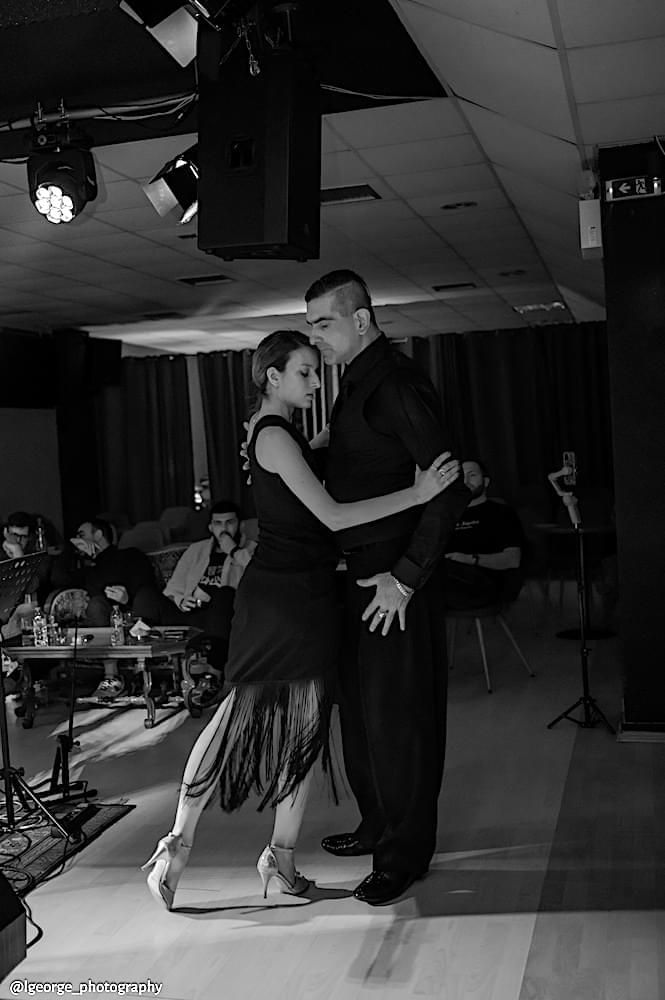
In the world of tango, where emotion is currency and silence often speaks louder than music, there exists a dangerous illusion: that the photographer is merely an observer.
George Liapes destroys that illusion.
https://instagram.com/lgeorge_photography/
Not quietly. Not politely. But frame by frame.
Working alongside the dance couple known as “Pablito & Efi”, Liapes does something most visual artists are too cautious, or too detached, to attempt: he refuses neutrality. His camera does not “capture” moments. It chooses sides. It builds mythology.
And that changes everything.
---
THE PHOTOGRAPHER WHO ENTERED THE DANCE
Most dance photographers arrive late. They observe from the edge of the floor, waiting for the “perfect” pose, the clean line, the symmetrical embrace.
Liapes does not wait.
https://instagram.com/lgeorge_photography/
He enters the emotional current of the room, where choreography dissolves and something more dangerous begins: truth without choreography.
In the visual universe surrounding Pablito & Efi, nothing feels staged. Not because it isn’t, but because Liapes strips away the visible scaffolding of performance and replaces it with narrative tension. A lifted hand becomes hesitation. A turn becomes conflict. An embrace becomes either salvation or surrender, depending on the frame.
This is not documentation. It is interpretation under pressure.
And beneath it all, something more unsettling is happening: the Gestalt principle of wholeness over parts begins to dominate perception. You no longer see “two dancers.” You perceive a field. A system. A relational organism where meaning is not located in one body or the other, but in the space between them.
---
PABLITO & EFI: TWO BODIES, ONE STORY—AND A THIRD AUTHOR
Every artistic couple eventually faces a hidden third presence: the one who defines how the world sees them.
In this case, that third presence is Liapes.
https://instagram.com/lgeorge_photography/
The Pablito & Efi aesthetic, raw, intimate, cinematic, almost accusatory in its emotional honesty, cannot be separated from the gaze that constructs it. The couple performs life, but Liapes edits memory.
And memory is never innocent.
From a Gestalt lens, what emerges is not a duet but a field of contact. The “contact boundary” between self and other becomes the true stage. Every photograph becomes an investigation of how identity forms at the edge of relationship.
Where does Pablito end? Where does Efi begin? And more importantly, who is observing whom?
The viewer is pulled into unresolved closure: the mind tries to complete the image, to stabilize it into meaning. But Liapes refuses completion. He leaves perceptual gaps on purpose, so the psyche must do the work.
That is not photography.
That is controlled psychological tension.
---
THE UNCOMFORTABLE QUESTION
At what point does documentation become authorship?
And at what point does authorship become influence?
Liapes operates in that dangerous borderland where photographers stop being witnesses and become invisible co-choreographers. He does not interfere with movement, but he interferes with meaning.
A simple glance between dancers becomes, in his framing, a negotiation of power.
A pause becomes a fracture.
A smile becomes resistance.
https://instagram.com/lgeorge_photography/
And in Gestalt terms, figure and ground constantly reverse. What was background becomes message. What was gesture becomes narrative anchor. The mind cannot settle, because the perceptual field refuses stability.
This instability is not a flaw, it is the method.
---
THE BODY AS AN UNFINISHED SENTENCE
Gestalt theory teaches that the human mind seeks closure. It completes incomplete patterns, fills missing structure, and organizes chaos into coherence.
Liapes weaponizes this instinct.
https://instagram.com/lgeorge_photography/
In his frames of Pablito & Efi, the body is never fully resolved. A lifted arm suggests an emotion that is never named. A leaning torso implies a decision that never arrives. A gaze holds just long enough to suggest confession, but not enough to confirm it.
The viewer becomes trapped in unfinished Gestalts.
And in that unresolved space, projection begins.
We do not see them as they are.
We see them as we need them to be.
---
WHY THIS MATTERS
Tango has always survived on illusion: the illusion of spontaneity, of improvisation, of emotional purity. But modern visual culture does not allow illusion to remain untouched.
George Liapes understands this better than most.
His work around Pablito & Efi does not protect tango from modernity, it exposes it to it. Brutally. Elegantly. Without apology.
But more importantly, it exposes something deeper: the way humans construct meaning through incomplete perception. The way we cannot not complete what we see. The way relationships, on and off the dance floor, are always interpreted through psychological need, not objective truth.
In that sense, every image becomes a therapeutic trigger.
Not healing.
Exposure.
https://instagram.com/lgeorge_photography/
---
THE FINAL FRAME
There are photographers who make dance look beautiful.
And there are photographers who make dance unavoidable.
George Liapes belongs to the second category.
And in doing so, he quietly shifts the question from:
“What did they dance?”
to
“What did your mind complete when it refused to let the image remain unfinished?”
Because in the end, the most powerful performance is not on the floor.
It is in the observer’s need to make meaning where none is given.
And Liapes knows exactly where that need begins.